

As clinical trials become increasingly complex, adaptive, and personalized, the tools we use to manage them must evolve. Yet, a fundamental friction persists across the industry: the separation of supply forecasting and Randomization and Trial Supply Management (RTSM).
For years, clinical operations have accepted a decoupled reality—running heavy forecasting simulations in isolated systems and attempting to manually translate those insights into operational execution through separate IRT vendors. This division introduces data latency, synchronization errors, and the perennial risk of “two systems talking to each other instead of thinking as one.”
The Cost of Decoupled Architectures
When forecasting and execution live on separate databases with distinct logic layers, agility suffers. In modern clinical environments, a delay in data transfer or a mismatch in supply assumptions isn’t just an administrative inconvenience—it risks drug wastage, budget inflation, and, in worst-case scenarios, trial disruption.
The Single-Engine Solution
True clinical supply optimization requires a paradigm shift: moving from reactive multi-system integration to a single-setup, single-algorithm, single-database approach. By unifying supply forecasting, production planning, and RTSM into a single backend, every patient randomization or kit dispensation instantly recalibrates the entire supply network in real time. There are no sync jobs, no export delays, and zero risk of mismatched assumptions.
The Ultimate Stress Test: Radiopharmaceuticals
This architectural demand is nowhere more urgent than in the realm of radiopharmaceuticals and advanced therapy medicinal products (ATMPs). Handling products with extremely short half-lives, complex manufacturing windows, and rigid distribution timelines exposes every weakness in a fragmented supply chain. When minutes matter and shelf-lives are measured in hours, a decoupled system cannot keep pace. Success requires end-to-end chain of command, custody, and identity operating seamlessly within a single, real-time ecosystem.
Meet Us at GCSG 2026
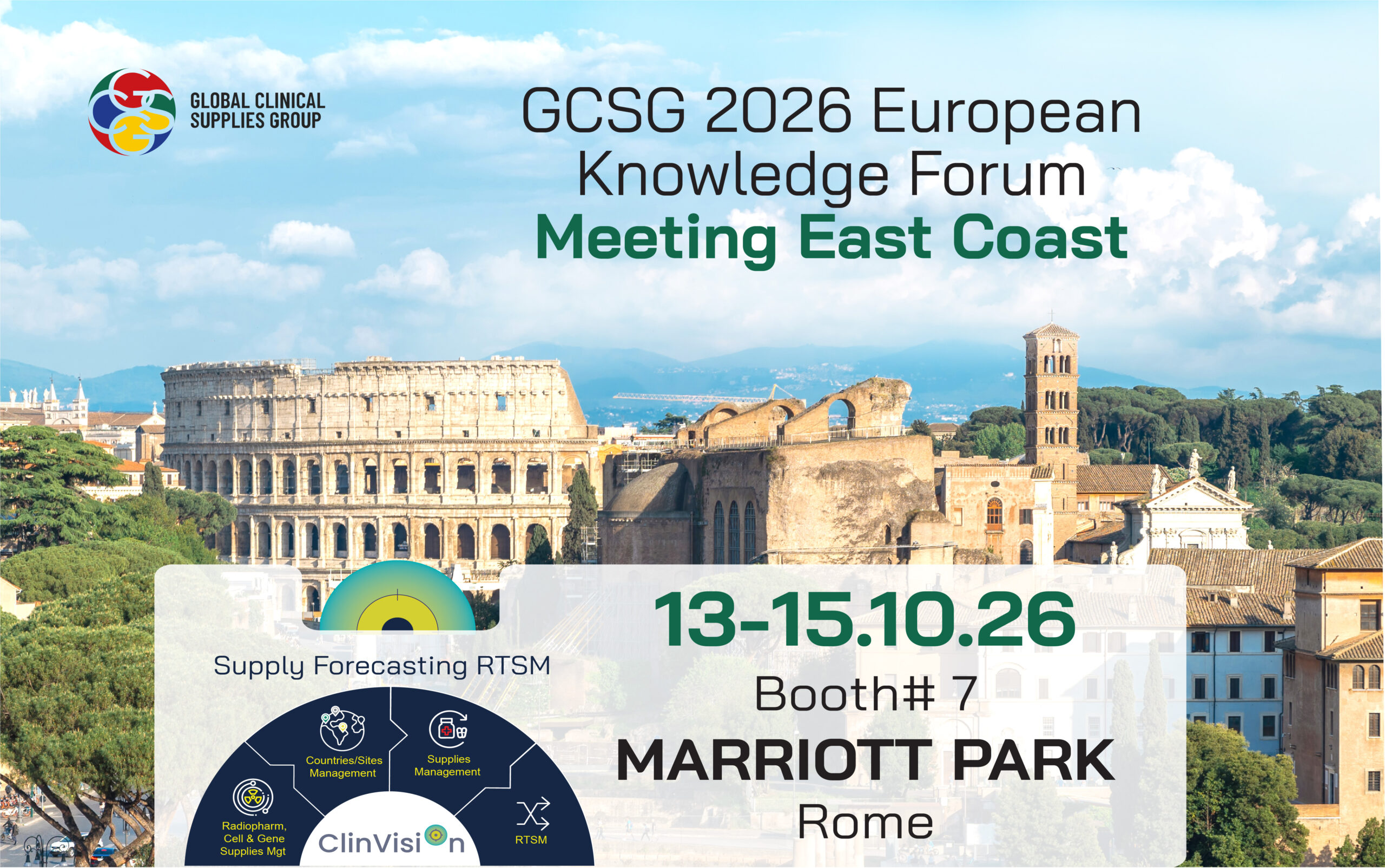
At the upcoming GCSG 2026 European Knowledge Forum (October 13–15), S-Clinica will dive deep into these exact challenges during our Vendor Showcase session alongside industry expert Katrien Aerts. We invite you to visit Booth #7 to explore how a unified platform approach eliminates waste, slashes setup times, and brings absolute precision to the most demanding clinical supply chains.
GCSG 2026 European Knowledge Forum
Meet with us at the GCSG.
Please proceed to this link to fill in your contact details.